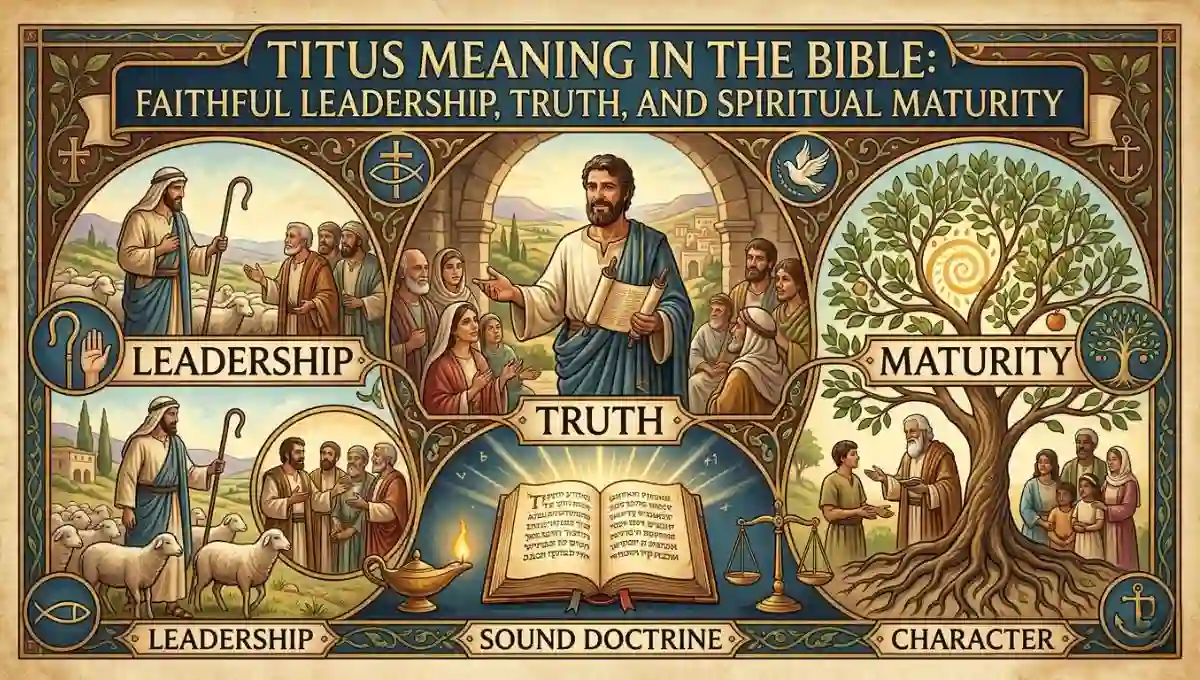
The Titus meaning goes far beyond a name. It represents honorable character, sound doctrine, and servant leadership that reshaped the early church.
Whether you’re doing a Titus Bible study or exploring Christian leadership principles, this guide reveals the full biblical and spiritual depth of this remarkable man.
Biblical Meaning of Titus
The name Titus comes from Latin and is understood to mean “honorable,” “strong,” or “defender.” The Titus meaning in Scripture lives up to every aspect of that definition through faithful service and moral strength.
The biblical meaning of the name Titus reflects honor, strength, and faithfulness in leadership. It is a name closely tied to sound doctrine in Christianity, godly character, and spiritual responsibility qualities the Apostle Paul both modeled and demanded.
Who Was Titus in the Bible?
Titus appears in the New Testament only as the young, non-Jewish associate of the Apostle Paul. His name occurs most in 2 Corinthians (ten times), twice in Galatians, once in 2 Timothy, and once in the Epistle to Titus.
Paul calls Titus his brother (2 Corinthians 2:13) and his true son (Titus 1:4).
Titus was one of Paul’s very dear and trusted friends. He was chosen by Paul to act as his delegate to Corinth to handle difficult and delicate work in the church there and he did this more than once, successfully, showing he was tactful, resourceful, and skillful in handling both people and affairs.
Understanding who was Titus in the Bible also means recognizing his role as a Gentile believer. Although Titus was a Gentile, he became a strong leader in the early church. Because of his deep faith and leadership abilities, Paul often sent him on important missions (Galatians 2:3, 2 Corinthians 8:16–17).
The Book of Titus
The Book of Titus was written by the Apostle Paul around A.D. 63. It is a pastoral letter to Titus, one of Paul’s trusted companions who was overseeing the churches on the island of Crete. In this letter, Paul provides guidance for establishing healthy church leadership, promoting sound doctrine, and encouraging believers to live godly lives as a testimony to the Gospel.
Paul left Titus behind to build stable churches with mature, qualified pastors for the people. This was especially needed in Crete, because the people there were known for moral corruption and dishonesty. Titus had to find and train capable leaders for the Christians of the island.
The Titus meaning is powerfully illustrated in this assignment “defender” placed in the most spiritually broken field. God chose this man precisely because of what his name and character stood for.
Key Bible Verses About Titus
The following verses capture the Titus meaning biblically and his relationship with Paul and the early church:
| Bible Reference | Key Message |
| Titus 1:4 | “To Titus, my true son in our common faith: Grace and peace from God the Father and Christ Jesus our Savior.” |
| Titus 1:5 | “The reason I left you in Crete was that you might straighten out what was left unfinished and appoint elders in every town.” |
| Titus 1:9 | An elder must hold firmly to the trustworthy message so he can encourage others by sound doctrine. |
| Titus 2:1 | “Speak the things which are fitting for sound doctrine.” |
| Titus 3:5 | God saved us “not because of righteous things we had done, but because of his mercy.” |
| 2 Corinthians 8:23 | “Whether any inquire about Titus, he is my partner and fellow-worker.” |
These Titus Bible verses reveal a man anchored in biblical truth, trusted with leadership, and devoted to the mission of God.
Must Read: Rafa Meaning in the Bible
Titus as a Model of Christian Leadership
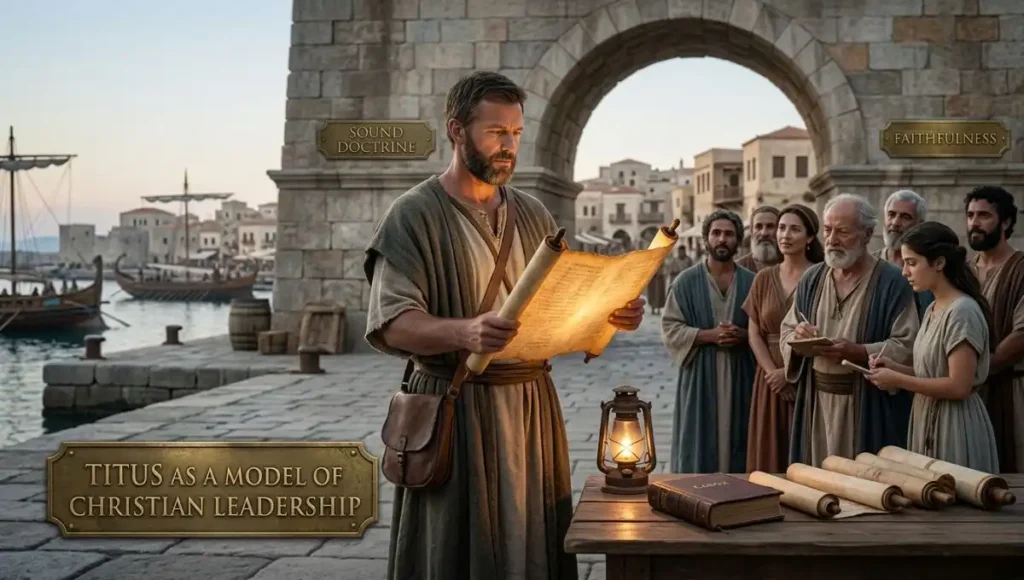
One of the clearest themes in the Titus meaning is his model of godly leadership. Paul did not just appoint Titus he equipped him with clear instruction, personal mentorship, and authority to act.
Paul opens by addressing Titus as his “true child in a common faith” and immediately urges him to “set in order what remains” in the churches of Crete, emphasizing the importance of solid leadership and doctrinal teaching, knowing that strong foundations are crucial for church stability.
These godly standards are best seen through the qualities Paul required of him:
- Blameless character living above moral reproach
- Hospitality welcoming others with an open heart
- Self-control managing emotions, desires, and speech
- Sound doctrine ability to teach and defend biblical truth
- Refuting false teachers protecting the flock from error
Paul’s exhortations to Titus highlight the need for integrity, strong moral conduct, and adherence to the core teachings of the Gospel. Paul calls Titus to rebuke false teachers and protect the church from harmful influences.
These are biblical leadership qualities every Christian leader, pastor, elder, or deacon must carry today.
Spiritual Significance and Symbolism
The spiritual meaning of Titus runs deep. His life was not accidental. God used Titus to demonstrate that spiritual maturity, faithful service, and Christian character development are accessible to every believer.
A Picture of Spiritual Growth
The Titus meaning spiritually is deeply connected to maturity in faith. Titus represents a believer who has grown beyond spiritual infancy. He wasn’t born a leader; he was shaped by mentorship, obedience, and tested in real ministry challenges.
The Titus spiritual meaning challenges every Christian: growth is not passive. Like Titus, we must embrace discipleship, accept hard assignments, and trust God in difficult places.
Integrity in a Corrupt World
Crete was morally broken. Yet Titus was planted there to build something holy. Paul was convinced that Spirit-empowered faithfulness to the teachings of Jesus would declare God’s grace all over the island of Crete and the world. He calls on these Christians to wisely participate in Cretan culture, rejecting what’s corrupt while embracing what’s good.
This is the Titus symbolism in Christianity that speaks to modern believers that you can live with integrity in a corrupt world. Faith and godly character don’t require a perfect environment.
Teaching by Example
Paul exhorted Titus to “speak the things which are fitting for sound doctrine” (Titus 2:1), a clear direction that this should be the young pastor’s primary role. But Titus was also called to model what he taught.
This principle leadership according to the Bible means that servant leadership in Christianity is never just words. It is a life that preaches louder than sermons.
Biblical Interpretations in Dreams or Real Life
Many people searching for the Titus meaning do so because they encountered the name in an unexpected way through a dream, a sign, or a strong impression during prayer.
Seeing the Name Titus in a Dream
If you see the name Titus in a dream, consider its core biblical associations:
- A call to leadership: Are you being invited into a new role of responsibility?
- A season of order Like Titus in Crete, God may be calling you to bring structure and truth to a disordered situation.
- A mentorship connection The Titus and Paul relationship points to the power of spiritual covering and discipleship.
- A reminder of faithfulness God honors those who remain steady in difficult seasons.
The Titus meaning often emphasizes faithfulness, leadership, and trustworthiness. Paul entrusted him with important missions, showing that Titus symbolized someone who carries God’s work faithfully.
Emotional Context Matters
Always interpret spiritual impressions in light of your current season. A dream about Titus during a time of confusion may signal a call to sound doctrine. During a leadership transition, it could be God’s confirmation to step forward with courage and integrity.
The prophetic meaning of Titus is not about prediction, it is about alignment with the biblical values Titus embodied: faithfulness, obedience to God, and sound teaching.
Practical Lessons & Faith Insights
The lessons from the Book of Titus are timeless. Here is what every believer can take away from the Titus meaning in Scripture:
| Lesson | Scripture Anchor | Application |
| Character precedes calling | Titus 1:6–9 | Your inner life qualifies your outer leadership. |
| Sound doctrine protects the church | Titus 1:9, 13 | Knowing what you believe guards against deception. |
| Grace produces good works | Titus 3:5–8 | Salvation is by grace obedience flows from it. |
| Mentorship multiplies ministry | Titus 1:4–5 | Invest in the next generation of leaders. |
| Faithfulness in hard places honors God | Titus 2:10 | Difficult assignments are divine opportunities. |
What can Christians learn from Titus?
- Never underestimate quiet, faithful people; they often carry the heaviest loads.
- Sound teaching is not optional; it is the backbone of a healthy church.
- Christian discipleship requires real accountability and real relationships.
- How Titus helped the early church teaches us that one person, fully surrendered to God, can transform an entire community.
The characteristics of Titus in Scripture integrity, teachability, courage, and loyalty are a blueprint for Christian maturity in every generation.
Conclusion
The Titus meaning is a rich, layered portrait of what God can do through one faithful person. Titus was not the most famous disciple. He wrote no Gospel. Yet his life shaped the early church in Crete and continues to instruct believers today through the Epistle to Titus.
He was a Greek Gentile who became a trusted spiritual son. He was placed in one of the hardest mission fields and did not flinch. He taught sound doctrine, appointed godly leaders, and lived with integrity while the world around him was corrupt.
The Titus meaning ultimately points us to three unchanging callings: lead faithfully, teach truthfully, and live godly. Whether you carry this name, study this character, or encounter it in a dream, the message is clear: God still calls ordinary people to extraordinary faithfulness.
Embrace the calling. Build with integrity. Teach with courage. That is the Titus way.
Frequently Asked Questions
What does Titus mean in the Bible?
The Titus meaning in Latin is “honorable” or “defender.” Biblically, it represents faithful leadership, sound doctrine, and godly character.
Who was Titus in the New Testament?
Titus was a Greek Gentile believer, a trusted companion of Paul, and a church leader sent to organize the churches on the island of Crete.
Why did Paul write the Book of Titus?
Paul wrote to guide Titus in appointing qualified elders, teaching sound doctrine, and correcting false teachers in Crete’s young churches.
What is the main message of the Book of Titus?
The main message is that grace transforms character, and true Christian living is marked by integrity, sound teaching, and godly leadership.
What is the spiritual significance of Titus?
Titus spiritually symbolizes maturity, faithfulness, servant leadership, and the power of mentorship in Christian discipleship.

Khurram Ali is a dedicated content writer at BiblesGalaxy.com, specializing in Bible verses, biblical meanings, and spiritual insights. He creates well-researched, engaging, and easy-to-understand content that helps readers explore the deeper messages and teachings of scripture. With a strong focus on clarity, authenticity, and SEO-friendly writing, Khurram aims to provide valuable and inspiring content for those seeking faith, guidance, and a stronger connection with the Bible.