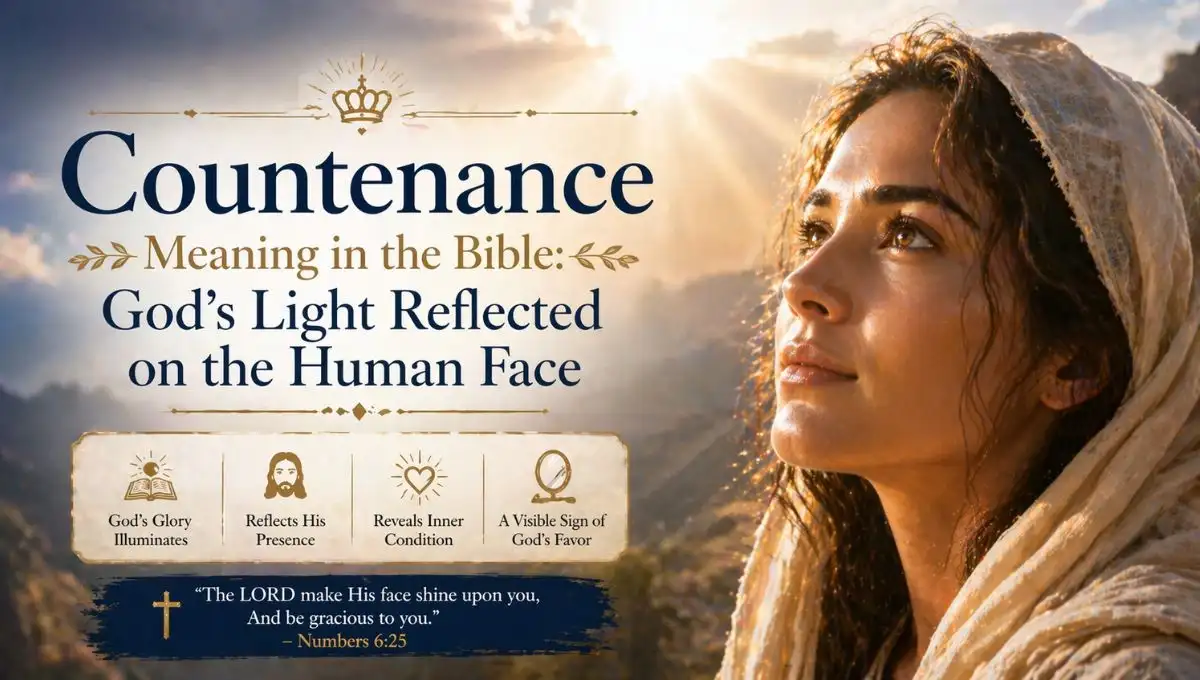
Your face often reveals what words cannot. In the Bible, your countenance represents much more than physical appearance; it reflects the condition of your heart, your relationship with God, and the presence of His work within your life. The biblical meaning of countenance carries deep spiritual symbolism, connecting emotions, character, favor, and divine connection.
Throughout Scripture, from Genesis to Revelation, countenance appears as a powerful reflection of God’s presence, human emotions, inner struggles, and spiritual transformation. Exploring this word meaning in the Bible helps us understand how God sees us, how we reflect His glory, and how our inner faith shapes the way we face the world.
Quick Answer: Countenance Meaning in the Bible
In the Bible, countenance refers to the expression or appearance of a person’s face as it reflects their inner spiritual and emotional condition. It also describes God’s face, His presence, favor, and glory shining upon His people.
| Feature | Detail |
| Primary Hebrew Word | Pānîm (פָּנִים) face, presence |
| Primary Greek Word | Prosōpon (πρόσωπον) face, appearance |
| Key Verse | Numbers 6:25 “The Lord make His face shine upon you” |
| Core Meaning | Inner spiritual state revealed outwardly through the face |
| Used Of | God, humans, angels, and spiritual transformation |
What Does Countenance Mean in the Bible?

The biblical meaning of countenance is richer than a modern dictionary can fully capture. Today we rarely use the word but in Scripture, it appears over 100 times, woven into stories of glory, grief, faith, and divine encounter.
At its heart, countenance in the Bible means the face as a living expression of what is happening inside the heart. Proverbs 15:13 captures this perfectly: “A joyful heart makes a cheerful face, but when the heart is sad, the spirit is broken” (NASB). This verse reveals that your spiritual condition does not stay hidden; it rises to the surface of your face.
The biblical writers understood this better than most modern readers. To them, the face as a reflection of the heart was not poetry, it was spiritual reality. A person’s countenance revealed whether they walked in God’s peace, wrestled in sin, or carried unspoken burdens in their soul.
The Hebrew and Greek Words Behind “Countenance”
Understanding the original languages opens the door to the full depth of this word. The Bible was not written in one tongue, and each language adds unique texture to the countenance definition in scripture.
Hebrew Words for Countenance:
| Hebrew Word | Transliteration | Meaning |
| פָּנִים | Pānîm | Face, presence, appearance |
| מַרְאֶה | Mar’eh | Appearance, vision, form |
| תֹּאַר | To’ar | Shape, figure, form |
| עַיִן | Ayin | Eye (used for expression) |
| זִיו | Ziw (Aramaic) | Brightness, splendor |
Greek Words for Countenance:
| Greek Word | Transliteration | Meaning |
| πρόσωπον | Prosōpon | Face, presence, person |
| ὅρασις | Horasis | Vision, appearance |
| στυγνάζω | Stugnazo | To look gloomy, face falling |
To the ancient Oriental reader, the countenance mirrored the character and feelings of the heart even more vividly than it does in modern Western culture. This is why the biblical writers returned to it again and again; they saw the face as a theological statement, not merely a physical feature.
The Aramaic word ziw, found in Daniel, refers to a brilliance or splendor used specifically to describe how Daniel’s countenance changed under the weight of divine visions (Daniel 7:28). It paints a picture of a face literally altered by contact with heaven.
Countenance and the Presence of God
Perhaps the most powerful use of God’s countenance meaning appears in the Aaronic blessing of Numbers 6:24–26:
“The Lord bless you and keep you; the Lord make His face shine upon you and be gracious to you; the Lord lift up His countenance upon you and give you peace.”
The word pānîm here carries extraordinary weight; its meaning includes appearance, presence, being shown honor, being under direction, being under blessing, being supervised, being favored, and being given an audience. That is an entire theology packed into one small Hebrew word.
In Greek, the word for looking in this context comes from aphorao, which carries the idea of looking away from everything else to focus your gaze upon one thing alone. When God lifts His countenance upon you, He is not glancing. He is locking His full attention on you with undivided love.
When God’s countenance shines, it represents His favor, His presence, His blessing, His supervision, and His peace all given simultaneously to the one He loves. This is why the priestly blessing was not merely ceremonial. It was a declaration that God’s very face was turned toward His people.
When Countenance Falls: A Biblical Warning
The Bible also gives a sobering image on the other side of this truth. In Genesis 4:5–6, after Cain’s offering was rejected, God asked him a penetrating question: “Why are you angry? Why has your countenance fallen?”
In biblical language, a fallen countenance means looking despondent and disappointed, the face cast down in the shadow of an unresolved spiritual issue. Cain’s face revealed what his heart was hiding. And God, in His mercy, addressed the face to reach the heart.
This pattern appears throughout Scripture. Why does countenance fall in the Bible? The reasons are consistent:
- Unresolved sin Cain (Genesis 4:5)
- Spiritual neglect when prayer and worship are abandoned
- Grief without hope Hannah before she prayed (1 Samuel 1:18)
- Disobedience Saul’s face changed after rebellion (1 Samuel 16)
- Distance from God the soul that wanders loses its radiance
The spiritual insight here is not meant to condemn, it is meant to alert. A fallen countenance is not a verdict; it is an invitation to return.
Spiritual Meaning of Countenance in Christian Life

The spiritual meaning of countenance in Christianity goes far deeper than mood or emotion. It speaks to the condition of the whole person’s body, soul, and spirit before God.
Psalm 34:5 says: “Those who look to Him are radiant; their faces are never covered with shame” (NIV). This is a stunning promise. When believers consistently orient themselves toward God in worship, prayer, and dependence a visible change takes place. The shame lifts. The heaviness dissolves. The face reflects what the spirit has received.
This is not wishful thinking. It is a documented pattern throughout Scripture. Hannah’s face was no longer sad after she prayed (1 Samuel 1:18). Nehemiah’s sad face before the king revealed an internal burden that God was about to turn into a great mission (Nehemiah 2:2–3). In both cases, the face told the truth and the truth opened the door to God’s intervention.
Don’t Miss : Eliana Meaning in Bible: A Beautiful Name Rooted in God’s Answer
Countenance as a Sign of Inner Transformation
One of the most breathtaking illustrations of spiritual transformation visible outwardly is the story of Moses descending Mount Sinai. When Moses came down from Mount Sinai with the two covenant tablets in his hands, he was unaware that the skin of his face shone brightly because he had been talking with God.
This illumination was a physical manifestation of the spiritual encounter he had with the Almighty. The brilliance of Moses’ countenance was a reflection of the divine glory he had been exposed to in God’s presence.
As C.H. Spurgeon powerfully observed: “God is light, and they that look upon him are enlightened, and reflect light around them. Moses spoke with God face to face as a man speaks with his friend, and this made his countenance glow.”
This is the pattern for every believer. As the sun shines upon a reflector and its light is thrown back in a brilliant fashion, so the face of Moses reflects the glory of the Lord, a saint shines on others when God has first shone on him.
The inner transformation always precedes the outward radiance. You cannot manufacture a shining countenance. It is the natural overflow of genuine time spent in God’s presence.
How Countenance Reflects Spiritual Authority and Peace
In the New Testament and throughout the Old, a settled and radiant countenance carried spiritual authority. When Paul describes believers in 2 Corinthians 3:18, he writes: “We all, with unveiled faces, beholding the glory of the Lord, are being transformed into the same image from glory to glory.”
Paul’s imagery draws directly from Moses; the veil that Moses wore became a symbol of the spiritual blindness that kept people from grasping the glory of God. In Christ, that veil is removed, allowing believers to behold God’s surpassing glory and be transformed from glory to glory.
A believer who walks in genuine surrender carries a countenance that communicates peace without saying a word. This is not personality, it is the light of God in believers, shining outward from an inwardly transformed spirit. People in hospital rooms, in courtrooms, in crisis they notice when a face carries something different. That difference is God’s presence made visible.
Jesus and Countenance in the New Testament
The most glorious countenance in all of Scripture belongs to Jesus Himself. At the Transfiguration on the mountain, something extraordinary happened: “His face shone like the sun, and His clothes became as white as the light” (Matthew 17:2).
Luke 9:29 records that His countenance was altered, and His raiment became white and glistering a moment where the eternal glory of God broke through the veil of human flesh.
In Revelation 1:16, the resurrected and glorified Christ appears to John: “His face was like the sun shining in all its brilliance.” This is the fullness of divine countenanc not reflected glory like Moses, but the original source of all light itself.
Jesus also spoke directly about countenance in Matthew 6:16–17, warning against hypocrites who disfigure their faces to appear holy. He called His followers to a different kind of countenance one shaped by hidden devotion, not public performance. A face that carries genuine joy, not manufactured spirituality.
Dream Meaning of Countenance
The Bible records several significant dream-visions involving faces and countenance. When God communicates through dreams, a face or countenance often carries a specific spiritual message.
1. Bright or Shining Countenance
Dreaming of a bright or radiant face whether your own or another’s often points to divine favor, spiritual breakthrough, or the nearness of God’s presence. In Daniel 10:6, the heavenly messenger appeared with a face “like lightning.” A shining countenance in a dream may signal that God is drawing close, that answered prayer is near, or that spiritual growth is underway in your life.
2. Sad or Darkened Countenance
A sad or darkened face in a dream may represent unresolved grief, spiritual dryness, or an area of life where God is inviting honest prayer. It is not a judgment, it is a mirror. Nehemiah saw his own sadness honestly and allowed it to lead him into one of the most powerful prayers in the Old Testament (Nehemiah 1:4–11). A troubled countenance in a dream is often God’s invitation to lay a burden at His feet.
3. Seeing God’s Face
Perhaps the most profound dream experience in Scripture involves glimpsing the face of God. Jacob wrestled until dawn and declared, “I have seen God face to face, and yet my life has been delivered” (Genesis 32:30). Such a dream encounter often marks a turning point, a moment of deep identity shift, commissioning, or healing. If you dream of seeing a face of overwhelming light or holiness, approach it in prayer and Scripture, asking God to reveal what He is saying to your spirit.
Real Life Encounters With Countenance
Believers throughout history have noticed this biblical truth at work in their daily lives. Consider these patterns:
In a hospital room: A woman sitting at her dying husband’s bedside, deeply at peace not from medication, but from decades of prayer. Every nurse on the ward commented on the quiet light in her face. She was not pretending. She had spent herself in God’s presence, and it showed.
In a moment of repentance: A man who had carried secret sin for years described his face in old photographs as “heavy.” After genuine repentance and restoration, his wife told him his face looked younger. That is the countenance returning the inner healing becoming visible.
In persecution: The early church martyr Stephen, just before being stoned, had a face the witnesses described as “like the face of an angel” (Acts 6:15). His countenance did not reflect his circumstances; it reflected the God who was standing to receive him (Acts 7:55–56). This is the most powerful testimony of countenance in Scripture outside of Moses and Jesus.
These are not coincidences. They are the pattern God established divine presence and human expression are linked in ways that go far beyond psychology.
How Faith Shapes Our Countenance
Faith is not passive. It actively reshapes the face that we carry through the world. The heart and countenance connection in Scripture is consistent and clear: what you treasure, where you place your gaze, who you orient your life toward all of it eventually rises to the surface of your face.
| Spiritual State | Effect on Countenance | Biblical Reference |
| Joyful heart | Cheerful face | Proverbs 15:13 |
| Unresolved anger/sin | Fallen countenance | Genesis 4:5 |
| Time with God | Radiant face | Exodus 34:29 |
| Hopeful spirit | Health of countenance | Psalm 42:5 |
| God’s favor received | Lifted countenance | Numbers 6:26 |
| Grief surrendered to God | Countenance restored | 1 Samuel 1:18 |
Faith shapes countenance by changing what we love, what we fear, and who we trust. When fear decreases, the face softens. When hope grows, the eyes brighten. When peace rules the heart, even the body language of the face shifts into something the world cannot manufacture but can always recognize.
Practical Faith Lessons From Countenance
The countenance meaning in the Bible is not just theological, it is deeply practical. Here is how to apply it to your daily Christian life.
1. Check Your Heart
Before you ask why your countenance feels heavy, check what your heart has been feeding on. Have you spent time in resentment, anxiety, or fear? The face follows the heart. Proverbs 4:23 says to guard the heart above all else, because everything flows from it including what your face broadcasts to the world around you.
2. Seek God’s Presence
Moses’ countenance did not shine because he tried to look holy. It shone because he had been with God. Make time in prayer and Scripture non-negotiable. The Lord will draw attention to His presence when we reach out for Him and when we begin to feel the presence of God, we become peaceful. That peace will eventually show.
3. Release Burdens
A burdened countenance often reveals hidden carrying grief not surrendered, wounds not healed, worries not given to God. Peter’s instruction in 1 Peter 5:7 is direct: cast all your anxiety on Him, because He cares for you. The act of releasing produces visible relief. The countenance lifts because the spirit is lighter.
4. Reflect God’s Light
You are designed to be a reflector, not a generator. You cannot produce spiritual radiance from within yourself but you can position yourself toward the One who is the source of all light. In order to accomplish our spiritual purpose, we must experience intimate oneness with God and as Jesus said in the Sermon on the Mount, we must let our light fully shine.
Countenance and Hope in Hard Seasons
One of the most honest questions in the entire Psalter appears three times: “Why are you cast down, O my soul? And why are you disquieted within me?” (Psalm 42:5, 11; 43:5). Each time, the psalmist answers his own question with a declaration of hope: “Hope in God, for I shall yet praise Him.”
This is countenance theology at its most human. The writer does not pretend his face is bright when it is dark. He names the heaviness honestly and then chooses to anchor his soul in God anyway. This is the biblical model for hard seasons: not forced smiling, but honest faith that refuses to let circumstances have the final word over your spirit.
The countenance in Old Testament meaning shows us that even the greatest servants of God had dark nights Hannah wept, David’s face fell, Elijah collapsed under a broom tree. But in every case, God responded to the honest countenance. He did not turn away from the fallen face. He met it with compassion and purpose.
God Lifts the Countenance of His People
The phrase “God lifts the countenance” is not figurative language. The Hebrew word nasah means to lift up so as to draw attention to that which is lifted. God is drawing your attention to His presence, making Himself known to you so that He may bring you peace.
What does it mean when God lifts your countenance? It means:
- He restores what shame has broken the face that was cast down rises again
- He replaces grief with purpose Hannah’s countenance was no longer sad after she prayed and received God’s answer
- He removes fear the disciples who saw the transfigured Christ fell on their faces in terror; Jesus touched them and said, “Rise, and do not be afraid” (Matthew 17:7)
- He gives His peace the blessing of Numbers 6:26 is ultimately fulfilled in Christ, who said, “My peace I give to you” (John 14:27)
The lifting of your countenance is one of the most personal acts of God. He does not merely adjust your circumstances He reaches down and lifts your face toward His own.
Final Thoughts: Your Face Matters to God
The countenance meaning in the Bible carries a message for every believer: your face is not spiritually neutral. It is a living testimony of what is happening between you and God. It cannot be permanently faked, and it does not need to be.
When you draw close to God in honesty, in surrender, and in worship, your countenance begins to carry something that the world recognizes even when it cannot name it. It is the light that Moses carried down from the mountain. It is the radiance that Stephen carried into his martyrdom. It is the peace that surpasses understanding and it shows.
God sees your face. He knows what it is carrying right now the joy, the grief, the quiet exhaustion, or the tentative hope. And His word to you is the same ancient blessing spoken over His people thousands of years ago: “The Lord lift up His countenance upon you and give you peace.” That blessing is still being spoken. And your face is still the canvas on which God wants to display His glory to the world.
FAQs
What is countenance in the Bible?
Countenance in the Bible refers to the face or expression of a person that reveals their inner spiritual and emotional condition, and also describes God’s face as a symbol of His presence, favor, and glory toward His people.
Why is countenance important in scripture?
Countenance is important because the Bible consistently presents the face as a mirror of the heart showing whether a person walks in God’s peace, carries unresolved sin, or has been in God’s transforming presence.
How does God affect a person’s countenance?
God affects countenance by drawing near in presence, lifting spiritual burdens, restoring joy through repentance, and shining His divine light upon those who turn their faces toward Him producing visible radiance and peace.
What does a fallen countenance mean?
A fallen countenance in the Bible means a face that looks despondent, cast down, or troubled usually reflecting unresolved anger, sin, grief, or spiritual distance from God, as seen in Cain’s story in Genesis 4:5–6.
Can your face reflect your spiritual state?
Yes, absolutely. Scripture teaches this repeatedly from Proverbs 15:13 to Moses’ shining face to Psalm 34:5 that the inner spiritual condition of a believer is often made visible outwardly through their countenance.
What does the shining of God’s face mean spiritually?
God’s face shining upon someone in the Bible means He is granting His full favor, attention, blessing, and peace a declaration that He is actively present with that person and turning His love toward them without reservation.
What does countenance mean in Hebrew and Greek?
In Hebrew, the primary word is pānîm, meaning face, presence, and favor. In Greek, it is prosōpon, meaning face or appearance. Both words carry a depth of meaning that connects the visible face to inner spiritual reality and divine presence.
How does faith affect your appearance in the Bible?
Faith reshapes the inner person replacing fear with trust, grief with hope, and shame with dignity and these inner changes naturally surface on the face over time, producing the radiance and peace that Scripture associates with genuine fellowship with God.
What is the biblical explanation of inner peace showing outwardly?
The Bible teaches that when God’s peace rules the heart (Colossians 3:15), it does not stay hidden inside. It flows outward through the face, the eyes, and the whole bearing of a person becoming a silent witness to God’s work in their life.

Khurram Ali is a dedicated content writer at BiblesGalaxy.com, specializing in Bible verses, biblical meanings, and spiritual insights. He creates well-researched, engaging, and easy-to-understand content that helps readers explore the deeper messages and teachings of scripture. With a strong focus on clarity, authenticity, and SEO-friendly writing, Khurram aims to provide valuable and inspiring content for those seeking faith, guidance, and a stronger connection with the Bible.