
The Isaiah meaning in the Bible is one of Scripture’s most powerful truths wrapped inside a single name. Before Isaiah ever spoke a prophecy, his name already announced God’s greatest mission: salvation.
He wasn’t just a prophet delivering messages from a distant God. He was a living message walking among broken people. Understanding what the Isaiah meaning in the Bible truly conveys unlocks the entire arc of God’s redemptive story from judgment and sorrow to restoration and eternal hope.
Biblical Meaning of Isaiah in the Bible
The Isaiah biblical meaning goes far beyond biography or historical record. When we examine the Isaiah meaning in the Bible carefully, we discover it is at once a name, a mission, and a promise. Isaiah is widely called the “Fifth Gospel” a title earned because his writings anticipate Jesus Christ with stunning precision. Across 66 chapters, two dominant themes pulse together in perfect tension: judgment and hope.
God used Isaiah to speak to covenant people who had spiritually drifted. The message was honest and urgent: sin carries consequences, and God is holy. But woven through every warning was a golden thread of promise: God has not abandoned you.
Key biblical themes in the Book of Isaiah:
| Theme | What It Reveals |
| Judgment | God is holy; sin brings real consequences |
| Hope | Restoration is promised to the repentant |
| Salvation | God alone is the source of true deliverance |
| Messiah | A Savior is coming the plan was always in place |
| Redemption | Even the most broken stories can be rewritten by God |
Isaiah bridges the law and grace showing a God who is both perfectly just and overwhelmingly loving.
Origin and Hebrew Meaning of the Name Isaiah

To understand the meaning of the name Isaiah in Hebrew, you have to trace it back to its root: Yesha’yahu (יְשַׁעְיָהוּ). This ancient name translates literally as “The Lord is salvation” or “Yahweh saves.”
The name is built from two Hebrew elements:
- Yesha (יֵשַׁע) salvation, deliverance, rescue
- Yahu (יָהוּ) a shortened form of Yahweh, God’s personal covenant name
This is not merely interesting etymology, it is a theological declaration. Before Isaiah stepped into a temple or stood before a king, his name carried humanity’s most urgent answer: Who saves us? God. Only God.
The Isaiah name meaning reminds every believer that salvation is never a human achievement. It cannot be earned through performance, ritual, or religious effort. It is a divine gift given freely by a God who pursues His people even when they run from Him.
Isaiah in Historical and Prophetic Context
Understanding the Isaiah Old Testament meaning requires stepping into the world he entered. Isaiah ministered under four kings of Judah Uzziah, Jotham, Ahaz, and Hezekiah spanning roughly 740 to 680 BCE. It was a turbulent, fear-filled era:
- Political collapse: Assyria was rising as a global military terror
- Moral decay: Leaders used power for personal gain, ignoring justice
- Spiritual idolatry: God’s people had exchanged their covenant for foreign gods
- Social injustice: The poor were exploited while religious rituals continued hollow and empty
Into this dark landscape and this is central to the Isaiah meaning in the Bible God’s call came to Isaiah in a moment of breathtaking drama. In Isaiah 6, he sees a vision of the Lord enthroned in glory, surrounded by seraphim crying:
“Holy, holy, holy is the Lord Almighty; the whole earth is full of His glory.“
Isaiah’s first response was collapse: “Woe to me! I am ruined! For I am a man of unclean lips.“
This defines why God chose Isaiah as a prophet not because he was polished, but because he was honest about his brokenness. A seraph touched his lips with a burning coal. His guilt was removed. Then came the question: “Whom shall I send?“
Isaiah’s answer echoes through history: “Here am I. Send me.”
That moment of surrendered willingness is still one of Scripture’s most powerful scenes.
Read It Also : Discover Stella Name Meaning: Origins, Spiritual Meaning, Nicknames & More
Spiritual Significance and Symbolism of Isaiah
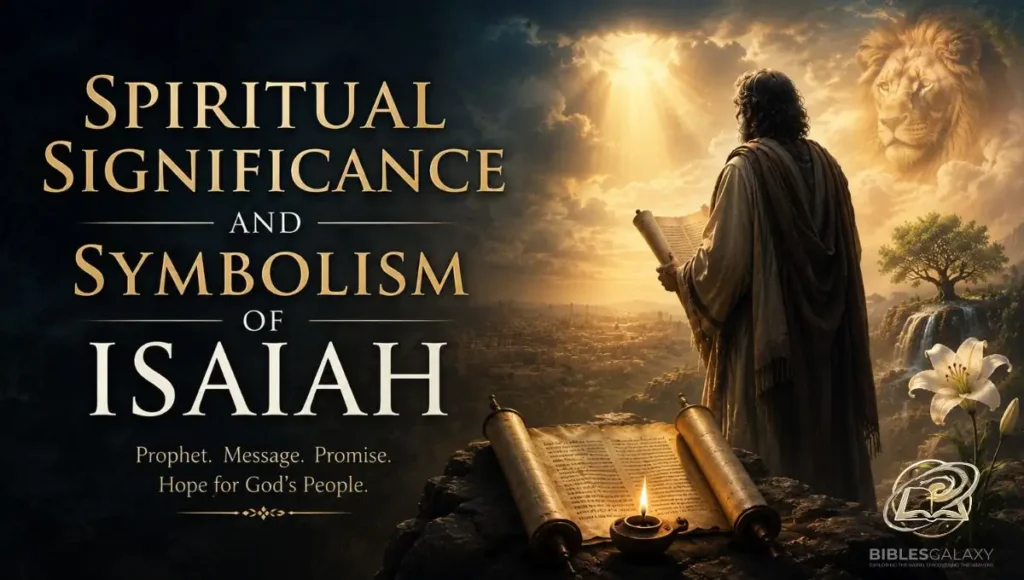
The spiritual meaning of Isaiah carries rich symbolism that still speaks directly to the modern believer’s journey. His life and writings, central to the Isaiah meaning in the Bible, are layered with spiritual symbolism:
The Purifying Coal (Isaiah 6:6–7) Fire in Scripture represents both judgment and purification. When the seraph touched Isaiah’s lips, it was not punishment, it was preparation. God cleanses us not to shame us but to equip us for something greater.
The Suffering Servant (Isaiah 52–53) These chapters describe a servant who suffers silently, bears the sins of others, and is ultimately vindicated by God. Christians universally recognize this as the most direct Messianic prophecy in the entire Old Testament fulfilled in the life and death of Jesus Christ. Nearly every verse of Isaiah 53 finds its echo in the Gospels.
Immanuel God With Us (Isaiah 7:14) “The virgin will conceive and give birth to a son, and will call him Immanuel.“ The Isaiah and Jesus prophecy connection is explicit Matthew 1:23 quotes this verse directly in describing the birth of Christ.
The New Creation (Isaiah 65:17) Isaiah closes with a vision of God making all things new, a promise that points beyond history to the eternal restoration of creation. The divine message of Isaiah is ultimately not warning but wonder: God wins, and He brings His people home.
Biblical Interpretations in Dreams or Real Life
Many believers encounter Isaiah unexpectedly through a dream, an unexpected verse in a devotional, or a verse that seems to leap off the page during a crisis. These moments rarely feel random. Here’s what they often signify:
- Isaiah 40:31 “Those who hope in the Lord will renew their strength” a message for exhaustion, burnout, and waiting seasons
- Isaiah 41:10 “Do not fear, for I am with you” God’s direct reassurance in moments of anxiety or danger
- Isaiah 53 An invitation to encounter the sacrifice of Christ in its most raw and personal form
- Encountering the name Isaiah in dreams often linked to a prophetic calling, a message God wants carried, or a season of deep spiritual refinement
These encounters carry the spiritual significance of Isaiah and the deeper Isaiah meaning in the Bible into the present moment, a reminder that God’s word is not a historical artifact but a living voice still speaking today.
Also Read: Nickelodeon Meaning in Latin
Practical Lessons & Faith Insights
The lessons from the Book of Isaiah for Christians rooted in the Isaiah meaning in the Bible are remarkably practical, even 2,700 years after they were first written. Here are five truths that still change lives:
1. God calls the broken, not the qualified. Isaiah’s first response to God was “I am unclean” and God used him powerfully anyway. You don’t need to have it together. You just need to say yes.
2. Judgment and love are not opposites. Every warning Isaiah delivered was a desperate invitation to return. Repentance and salvation are two sides of the same mercy God warns because He loves.
3. Hope is anchored, not wishful. Isaiah 40 one of the greatest passages of comfort in all Scripture was written to people in exile. God’s promise in Isaiah doesn’t require good circumstances to be valid. It is valid because God said it.
4. The Messiah was never an afterthought. From Isaiah 7 to chapter 53, the coming Savior is described in vivid detail. God’s plan of redemption was precise, intentional, and centuries in the making. Faith and trust in God grow deepest when we see how carefully He planned our rescue.
5. Salvation belongs to God alone. His very name says it: Yesha’yahu The Lord is salvation. Isaiah’s life, message, and legacy point to one truth: stop striving, start trusting.
Conclusion
The Isaiah meaning in the Bible is not simply a name study it is an invitation into the heart of God’s entire redemptive plan for humanity. From the fire in the temple to the Suffering Servant of chapter 53, from urgent warnings of judgment to breathtaking visions of restoration, Isaiah reveals a God who is holy enough to judge and gracious enough to save and shows us that these truths are not in tension but perfectly united in His character.
Whether you are exploring Isaiah for the first time or returning to its pages in a new season of life, the message remains alive and urgent. God still speaks through Isaiah’s words. His salvation, the one this prophet’s very name declared, is still offered freely to anyone willing to receive it.
FAQs
What does Isaiah mean in the Bible?
Isaiah comes from the Hebrew Yesha’yahu, meaning “The Lord is salvation” a name that perfectly summarizes his entire prophetic ministry and message to Israel.
Why is Isaiah important in Christianity?
Isaiah contains more Messianic prophecies than nearly any other Old Testament book, including the virgin birth (7:14) and the Suffering Servant (53), making it foundational to Christian theology and gospel proclamation.
What is the spiritual meaning of the name Isaiah?
Spiritually, the Isaiah meaning in the Bible represents divine calling, purification through God’s grace, and the declaration that true salvation and deliverance come only from Yahweh never from human strength or effort.
Is Isaiah a prophecy about Jesus Christ?
Yes. The Isaiah meaning in the Bible includes a clear prophetic dimension. Isaiah 7:14, 9:6, and chapters 52–53 are widely recognized as direct Messianic prophecies fulfilled in the life, suffering, death, and resurrection of Jesus Christ, confirmed throughout the New Testament.
What does Isaiah teach us about God’s salvation?
The Isaiah meaning in the Bible teaches that salvation is entirely God’s initiative, a gift of grace extended to those who repent and return to Him, offered not only to Israel but to all people across every nation.
Why did God choose Isaiah as a prophet?
God chose Isaiah for his willingness, not his perfection. When God asked “Whom shall I send?” in Isaiah 6:8, Isaiah responded “Here am I. Send me” a model of surrendered, courageous, Spirit-led obedience.

Khurram Ali is a dedicated content writer at BiblesGalaxy.com, specializing in Bible verses, biblical meanings, and spiritual insights. He creates well-researched, engaging, and easy-to-understand content that helps readers explore the deeper messages and teachings of scripture. With a strong focus on clarity, authenticity, and SEO-friendly writing, Khurram aims to provide valuable and inspiring content for those seeking faith, guidance, and a stronger connection with the Bible.