Have you ever heard the word Maranatha spoken in church and felt its weight without fully grasping its depth? The Maranatha meaning is one of the most spiritually charged phrases in all of Scripture ancient, Aramaic, and profoundly alive. Two syllables. Centuries of faith packed inside.
In this article, we unpack the Maranatha meaning from every angle: biblical, historical, spiritual, and practical. Whether you encountered it in a sermon, a worship song, or a quiet moment of Scripture reading, this word has something real to say to you.
Maranatha Meaning in the Bible
What Does Maranatha Mean?
The Maranatha meaning originates from Aramaic the everyday language Jesus spoke throughout His earthly ministry. It appears directly in the New Testament in 1 Corinthians 16:22, where the Apostle Paul uses it to close his letter to the Corinthian church with unusual intimacy and urgency.
Scholars typically read the Aramaic phrase two ways:
- Maran atha “Our Lord has come” (affirming the Incarnation a declaration of faith)
- Marana tha “Our Lord, come!” (a prayer of longing for Christ’s return)
Most early Christian tradition and biblical scholars favor the second reading. The Maranatha meaning, in that sense, is simultaneously a prayer, a declaration, and a cry of longing a believer’s soul reaching toward Heaven and saying: We are waiting. We trust. Come, Lord Jesus.
| Aspect | Detail |
| Language | Aramaic Jesus’ everyday spoken tongue |
| Key Scripture | 1 Corinthians 16:22; Revelation 22:20 |
| Core Translation | “Come, Lord” / “Our Lord, Come” |
| Used By | Apostle Paul and early church communities |
| Tone | Hope, urgency, longing, and active faith |
A Message of Hope
At its heart, the Maranatha meaning is a message of unshakable, living hope. The early believers who lived by this phrase were not comfortable people; many faced brutal persecution, imprisonment, and martyrdom. Yet this single Aramaic word carried them forward.
It told them: You are not abandoned. This suffering is not the end. Christ is returning. That is Christian hope in its purest form not wishful thinking, but a confident expectation anchored in God’s promises and the certainty of Christ’s return.
A Gentle Warning and Reminder
There is also a sober undercurrent in the Maranatha meaning. The full text reads: “If anyone does not love the Lord, let him be accursed. Maranatha” (1 Corinthians 16:22).
This is not a harsh threat from Paul. It is a loving, urgent divine reminder: Jesus is coming, and how we live today matters. The Maranatha meaning here calls every believer to live with awareness to love deeply, forgive genuinely, and keep the heart aligned with the Lord whose return is certain and near.
Spiritual Significance and Symbolism
A Cry From the Heart
Beyond theology, the Maranatha meaning carries deep emotional and spiritual resonance. It is the believer’s heartbeat reduced to a single word a prayer that holds everything at once:
- A declaration of Jesus’ lordship over all creation
- A longing for His presence and promised return
- A confession of complete dependence on God
- A hope rooted in biblical prophecy and eternal truth
When you understand the Maranatha meaning at this level, it stops being just a phrase. It becomes a posture of the soul, a daily orientation of the heart toward God and eternity.
Transformation and Trust
The spiritual meaning of Maranatha is inherently transformative. Praying it genuinely means choosing:
- Trust over anxiety about the unknown
- Eternal perspective over temporary frustration
- God’s timing over our own restless impatience
This is why Maranatha has long been embraced as a form of Christian meditation short, weighty, and true. It draws the heart away from noise and back to God.
Biblical Interpretations in Dreams or Real Life
In Dreams
Many believers report encountering Maranatha in dreams hearing it spoken, seeing it written, or sensing its meaning during sleep. In biblical dream interpretation, a divine word or name experienced this way often signals a spiritual awakening or a heavenly invitation from God.
If the Maranatha meaning appears in your dream, it may carry significance such as:
- A call to deepen your prayer life and relationship with Christ
- An invitation to refocus your heart on eternal things
- A reminder that God is near, active, and present in your situation
- A prompting to realign your daily choices with your faith and values
God has spoken through dreams throughout Scripture (Genesis 28, Acts 2:17). Encountering this ancient Aramaic word in a dream is worth bringing before God in quiet, prayerful reflection.
In Real Life
Encountering the Maranatha meaning through a Bible verse, a worship song, or a quiet spiritual prompting can carry real weight. It often surfaces when:
- You are walking through deep trials or prolonged grief
- You feel spiritually distant and crave God’s presence
- Your soul aches for something beyond this broken world
- You need reassurance that Christ’s return is real and personal
In every one of these moments, this ancient word speaks the same steady truth: Jesus sees you. He is coming. Hold on.
Must Read : Peyton Name Meaning in the Bible: Origin & Faith Insight
Historical and Early Christian Use of Maranatha
Maranatha in the Early Church
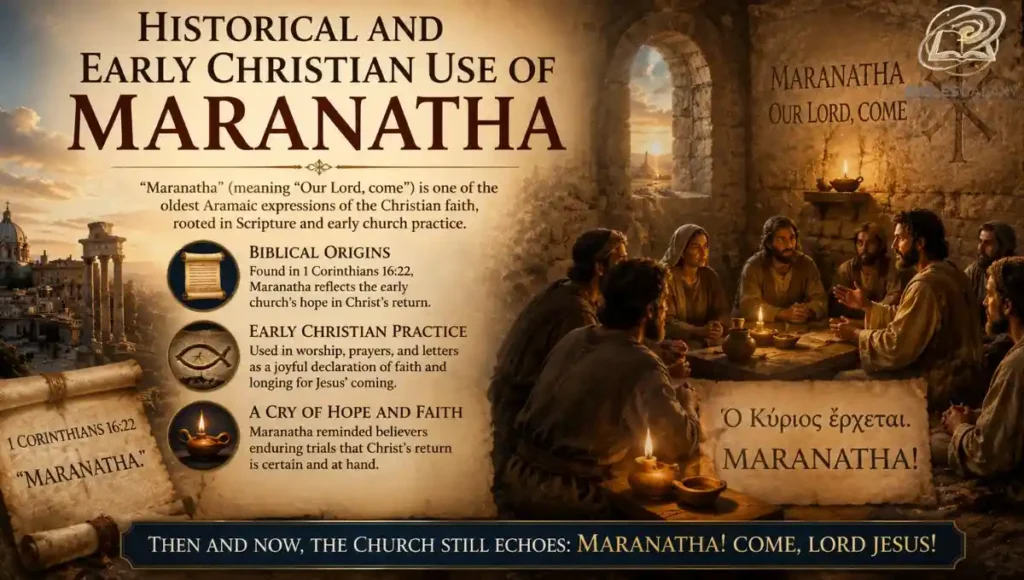
The Maranatha biblical meaning was not merely a private prayer it was woven into the communal fabric of early Christian worship. The Didache, one of the oldest surviving Christian documents outside the New Testament (circa first century AD), includes Maranatha in its Eucharistic prayers.
Early believers would speak this ancient cry together at the close of their gatherings. In the face of persecution, poverty, and profound uncertainty, it was their shared declaration: Jesus was real. His return is certain. We endure because we believe.
Its Connection to Prayer and Worship
The Maranatha prayer meaning has always been inseparable from worship. It mirrors the final exchange in Revelation 22:20 Jesus declares, “Surely I am coming quickly,” and the faithful respond, “Even so, come, Lord Jesus.”
This divine dialogue is the heartbeat of Christian prayer across every era. The Maranatha meaning connects believers today to that same ancient conversation uniting the first-century church with every generation of faithful hearts since.
Maranatha and the Promise of Christ’s Return
A Reminder of Jesus’ Second Coming
The Maranatha meaning is inseparable from the doctrine of Christ’s second coming. Every time a believer prays or speaks this word, they are affirming one of Scripture’s most glorious and central promises: Jesus is coming again.
This is not allegory or sentimental wishful thinking. Biblical prophecy from Isaiah to Revelation points to a literal and glorious return of Jesus Christ. Maranatha stakes the believer’s entire hope on that promise, without reservation.
Living With Faith and Expectation
Understanding the Maranatha meaning transforms not just what you believe, but how you live every single day. Expectant faith is active, not passive. It naturally produces:
- Serving others with greater urgency and genuine love
- Forgiving freely because eternity is far bigger than any offense
- Praying boldly for God’s kingdom to advance here and now
- Holding loosely to material things that will not survive eternity
- Encouraging others to hold on when hope feels impossibly distant
The second coming of Christ is not a distant theological idea; it is a daily spiritual reality for those who pray Maranatha and mean it.
Read It Also: The Powerful Biblical Meaning of the Name Kayden
Practical Lessons & Faith Insights
The Maranatha meaning offers clear, life-shaping lessons every believer can act on starting today:
- Make it your daily prayer. Begin or end each day with “Maranatha Come, Lord Jesus.” It is short, powerful, and deeply focused.
- Use it in hard seasons. When life overwhelms you, this ancient Aramaic prayer re-anchors your heart to God’s eternal, unshakable plan.
- Encourage others with it. Remind fellow believers that Christ’s return is real, that suffering is temporary, and that their hope is not lost.
- Let it govern your choices. If Jesus is genuinely coming, that truth should reshape how you spend your time, your money, and your words today.
- Let it fuel your worship. In quiet or in congregation, let Maranatha become the instinctive language of your spirit reaching toward God when human words fall short.
The early church endured unimaginable hardship on the strength of this single prayer. It still carries that same power across every century.
Conclusion
The Maranatha meaning is far more than a forgotten Aramaic phrase buried in a New Testament closing. It is a living prayer that has sustained faith for over two thousand years from the persecuted believers of Corinth to every faithful heart since. Rooted in 1 Corinthians 16:22 and echoed in the final breath of Revelation 22:20, this ancient cry carries one unbroken, luminous message: Come, Lord Jesus. It is hope given a voice, faith given language, and longing given a name that Heaven recognizes.
May the Maranatha meaning take root in your heart today and reshape the way you pray, the way you wait, and the way you walk through the ordinary and extraordinary moments of life. In a world that often feels uncertain, unjust, and spiritually exhausting, this one ancient word remains a steady, shining anchor. Jesus is coming. That promise changes everything. Maranatha.
FAQs
What is the Maranatha meaning in the Bible?
The Maranatha meaning in the Bible is an Aramaic phrase translating as “Come, Lord” or “Our Lord, Come,” found in 1 Corinthians 16:22 expressing the early church’s passionate longing for Christ’s return.
Is Maranatha a Hebrew or Greek word?
Despite being commonly searched as “Maranatha meaning in Hebrew or Greek,” it is actually Aramaic the everyday language spoken by Jesus and His first-century disciples in ancient Israel.
Why did early Christians say Maranatha?
Early Christians used Maranatha as a communal prayer during worship and the Eucharist, declaring their shared hope in the second coming of Jesus Christ even amid severe persecution and hardship.
Does Maranatha mean “Come Lord Jesus”?
Yes the Maranatha meaning is essentially the same heartfelt prayer found in Revelation 22:20: “Even so, come, Lord Jesus” a direct and urgent plea for Christ to return to His people.
What does Maranatha mean spiritually?
Spiritually, the Maranatha meaning represents the soul’s deepest longing for God’s presence, trust in His perfect timing, and an active, joyful hope in the fulfillment of His eternal promises.
Is Maranatha mentioned only once in the Bible?
The exact Aramaic word appears in 1 Corinthians 16:22, but its meaning is beautifully echoed in Revelation 22:20 making it a powerful bookend of Christian hope across the entire New Testament.

Khurram Ali is a dedicated content writer at BiblesGalaxy.com, specializing in Bible verses, biblical meanings, and spiritual insights. He creates well-researched, engaging, and easy-to-understand content that helps readers explore the deeper messages and teachings of scripture. With a strong focus on clarity, authenticity, and SEO-friendly writing, Khurram aims to provide valuable and inspiring content for those seeking faith, guidance, and a stronger connection with the Bible.